Gyakuten Saiban 1 English Patch
Dai Gyakuten Saiban 2: Naruhodou Ryuunosuke no Kakugo / The Great Ace Attorney 2: The Resolve of Ryuunosuke NaruhodouRelease Date: August 3rd, 2017 JapanDirector/writer: Shuu TakumiProducer: Motohide EshiroSummaryIt's been two years since we all boarded Mr. Takumi's wild ride, only to be stopped just before the loop-the-loop and told to deboard.
But for Ryuunosuke and co. It's only been a few months since they cracked the case of the unspeakable story. Now, a new crime in Japan leads an unexpected attorney to stand in court for the first time, and a new chain of cases to descend upon London.QuestionsWill this be officially released in English?Okay, but can I play it in English?recently won the rights to get their translation restored to YouTube, and they intend to sub DGS2 as well.The DGS1 fan translation patch team is still neck-deep in the first game, but they've already started updating their tools for DGS2.Do I have to have played/watched the first game to play/watch this one?Yes. Unlike every other AA game in the series, DGS2 is a direct sequel to DGS1, with the premise of its plot being that it will serve as a continuation and conclusion of DGS1's plotlines. I'm sure there will be some recapping in-game, but you'll lose a lot of the impact playing it before DGS1.Okay, I want to play DGS1 first.If you speak Japanese, a special double-pack of DGS1+2 (with a pack-in soundtrack) is available at most Japanese retailers and online. If you don't, or you can import a Japanese copy and wait for the fan translation patch.Any new features compared to DGS1?Not really. The main 'special' features in the game remain Joint Reasoning and the Jury Battles.I heard the soundtrack is the same as DGS1?From what we've heard, the vast majority of the courtroom tracks are reused from DGS1, as are a few others; however, DGS2's soundtrack releases next week, and is slated to have 40+ tracks, so there should be a good amount of new music.What are the episodes about?Shuu Takumi has said you'll have the best experience going in blind, but if you want to know the basics of each case:Episode 1.
London's World Fair gets off to a tragic start when a teleportation experiment ends in an explosion that kills a man. Ryuunosuke takes on the scientist's defense, but there seems to be much more lurking in the shadows. Episode 4:???Episode 5:???I played DGS1 but the lack of conclusion left me cold. This isn't just a setup for DGS3, is it?The dev team and reviews have been very explicit that they wrap up all of the DGS1 plotlines in this game, and Takumi's made comments to the effect that he feels he's told these characters' story now.Resources:for further discussion, rips, etc. disclosure, I help run this(as always, be very cautious of spoilers and misinfo immediately after release).
As the trailer and every advertisement for DGS2 has stated, 'Now all the mysteries will be answered'. I've assembled little summaries of said mysteries to look out for and to remind people who may have forgotten (and for you lizard people that don't care about spoilers).All these spoilers are from Dai Gyakuten Saiban 1 unless stated otherwise. I'm not going to be updating these as time goes on with 'answers' or whatnot. There are other, smaller mysteries as well, but I think they will be answered in the course of pursuing these main ones.I have no issue deleting these if it is considered too tempting or too much info.
Dai Gyakuten Saiban English Patch
I just think it's interesting to keep these in mind for a refresher or to keep in the forefront of our thoughts while playing, kind of like reviewing Virtue's Last Reward before Zero Time Dilemma came out. Hopefully this won't be as divisive.Also I want to see if I massively misread things.Case 1. We learn from the DGS2 web demo that it has been 9 months since that trial and finally after deliberations with England and Japan it was decided Jezail would be sent to Shanghai to undergo trial at an English court there. Jezail had a final request to go to a private beach for her last day in Japan which England accepted and pressured Japanese government to comply, which they quickly caved to again. However in a changing shack at the beach, Jezail was found stabbed to death making her the victim of the first case.Case 2.
One of the primary causes of the case's events is Iris lamenting the complications with one of her latest manuscripts. For people not in the know, Iris is the secret author of the 'Adventures of Sherlock Holmes' stories published in Strandts magazine while using her father as pen name. She writes her stories based on Holmes recounting his adventures to her but primarily she does so using a collection of journals her father, John Watson, wrote during his travels with Holmes. She had finished writing a new manuscript, 'Baskerville' and showed it to Holmes to proof read and permission to publish it. Instead in a rare showing of genuine sternness from Holmes, he forbade her from publishing the story and not only that but deposited the manuscript to a local pawnshop, Hatch's Shop.
Susato expresses her disappointment at not being able to read about 'the Hound of the Baskervilles'. Iris turns serious and asks, '.How did you know the title?'
In their conversation, Iris only referred to her manuscript as 'Baskerville' yet Susato knew the entire title. Susato since then has refused to explain how even at the game's conclusion, but has promised to do so when the time is right. Van Zieks does not hold the Japanese people in high regard, calling them liars, tricksters, and traitors with no respect for law officers among many other decrying comments. It isn't until after the final trial concludes that he explains himself slightly to Naruhodo.
In the past, there was a Japanese person that Van Zieks had absolute faith in but later betrayed him. After meeting Naruhodo in Case 3, Van Zieks would intentionally take what the public considered 'simple cases with obvious culprits' such as Case 4 and 5 solely so he could observe Naruhodo. We also learn that five years ago, Van Zieks left the courts and it was then that he became known as 'The Reaper'. He never returned to court again until the events of Case 3. It's possible that the Reaper's curse is an exaggeration from a gossip-loving populace that resulted from some incident five years ago and this incident could be the reason he left the courts. What happened between Van Zieks and his Japanese friend, and what happened five years ago that made him leave the courtroom and be known as The Reaper of Old Bailey? The events of Case 3 and 5 originated in the aftermath of illegal trafficking of telegraph Morse code messages.
The message was eventually played in court, but it was determined to be secret code instead of Morse code so no one knew what the message actually said. Iris wrote down part of the message to attempt to translate it later and after the trial realized that the message was indeed Morse code but not in English. Rather it was done in 'Iroha' code, an early format of the Japanese alphabet, meaning this top secret and classified message from the English Empire was most likely sent to the Japanese Empire.
Using this knowledge, Susato decoded the partial message and found it was a list of names.' Asougi (Kazuma Asougi)A. Sasha (unknown)T. Gregson (Tobias Gregson)J. Watson (John Watson)These are the four.'
This message was so important that its recovery demanded the full force of Scotland Yard and even murders were committed to acquire it. What was this transmission? What is the significance and relationship of these four people?Still haven't caught on to how time zones work and didn't realize the digital version would get unlocked tomorrow morning while I'm at work. I took Thursday and Friday off so hopefully I can demolish it before I go back to work and before Youtube recommended videos show me every breakdown in their thumbnails -.

I was thinking you were exaggerating, but no, that was actually the greatest comedic breakdown ever.Unfortunately that was about all the case had going for it I thought.There was no sense of tension or development for Susato which made me really sad because of her statements near the start like this one moment making her 'hate being born a woman' or how the 'courts defend everyone yet don't accept women.' I know they couldn't 'solve' it since it was a historical fact, and it'd be really lame to have the other characters play it so on the nose to acknowledge how flawed that mindset of barring women just because Susato did a good job, but still I wish we did something with it.
I was really interested in seeing how Susato would've have responded and persevered in the face of that, but it's just given a line at the start and dropped.It's pretty much a case just to give context and setup for later events and that's crammed in the last five minutes. It makes for a good ending but the actual case was probably the tamest I can think of. Every case, even 1-1 had some semblance of changing your thinking about something but this was just.dull. You don't even poke one of the other witnesses mid-testimony. One of the things I noticed when replaying the series again recently before this launched was how well the control of information can be used for the best twists, with the worse examples always resulting from giving too much information too soon. This case did that A LOT. Crime scene photo has a glaring hole in the shack's wall.
Gee, I wonder where the knife came from? And that's the mid-game plot twist. You need to examine the pen early on and you find the reservoir with some liquid in it. Gee, I wonder where the poison was hidden?
And that's the closing twist.It's like the opposite of DGS1-1 where the first case was great but went on way too long while this one is dull but short. I suppose it evens out for me because -to be perfectly frank, outside of playing as Susato I couldn't give a shit about being in the Japanese Empire again. It's obvious that the meat of the story, both cast and conspiracies, is in England so the sooner we got back there the better.But I'm a cynical old man hipster that doesn't like anything, so there's that to consider.I think I'm actually going to start Case 2 tonight just to 'start DGS2 for reals' after some Splatoon. I was thinking you were exaggerating, but no, that was actually the greatest comedic breakdown ever.Unfortunately that was about all the case had going for it I thought.There was no sense of tension or development for Susato which made me really sad because of her statements near the start like this one moment making her 'hate being born a woman' or how the 'courts defend everyone yet don't accept women.'
I know they couldn't 'solve' it since it was a historical fact, and it'd be really lame to have the other characters play it so on the nose to acknowledge how flawed that mindset of barring women just because Susato did a good job, but still I wish we did something with it. I was really interested in seeing how Susato would've have responded and persevered in the face of that, but it's just given a line at the start and dropped. It's pretty much a case just to give context and setup for later events and that's crammed in the last five minutes. It makes for a good ending but the actual case was probably the tamest I can think of.
Every case, even 1-1 had some semblance of changing your thinking about something but this was just.dull. You don't even poke one of the other witnesses mid-testimony. One of the things I noticed when replaying the series again recently before this launched was how well the control of information can be used for the best twists, with the worse examples always resulting from giving too much information too soon. This case did that A LOT. Clearly showing Mr. Hat and the body getting hoisted into the air. That video just told you that the body was moved from the stage via wires at the very start of the case but no one acknowledges it until the very end.
It creates disconnect because you know more than the characters do so when they're struggling to answer something that the game clearly told you already it makes them appear less competent. Especially when the characters finally do explain that obvious point there was no prompt that justified how they finally caught up.Evidence should have two points to it: the initial fact and then a 'real' fact about it that is hidden until the case progresses and gives that secondary fact context and exposure. In DGS2-1's case it would've been better if.
You couldn't find the empty ink reservoir when examining it. Instead examining just told you about the emblem which makes Payne's argument the pen, the initials, moot and incriminates Mamemimo later. Then wait until the end of the case to have some line of action reveal that the pen is empty or that you see how this fountain pen works, making you realize the pen was actually the real murder weapon. Heck, he kept tapping his pencil on his tongue, couldn't that have been a more interesting way for the poison to be administered? Like he asks you 'There were no lip marks on her drinking glass!
How would I get her to take the poison? You can't prove that!' And you present the pen at this point. That would be similar to DGS1-1 and initially presenting the.
I thought Selden's treasure was hidden in a fake gas meter box. That padlock on it looked exactly like the key Viridian had and the first court day had the wasp lady and Mieterman talking about how tamper-proof the boxes were. Of course thinking on it, that wouldn't work since Mieterman checks the boxes every three days for coins. He'd notice a fake box. I also got stumped at the 'true killer' point because Viridian was in a coma on the night of the incident so I didn't even consider her.
I am surprised that they went through the trouble of having her paint on the stand and yet she didn't nothing with those props. Wasted opportunity.Still felt kind of rushed though.
These first two cases seem like they were going down a checklist of things they need to establish. 'Something's fishy with Japan's relationship with England: check. Asougi had something to do in England: check. Van Zieks hates the Japanese and he's The Reaper: check.' It reminds me of AA3 in that regard like how 3-2 was mainly meant to refresh on Spirit Channeling and the extended Fey family tucked away in a murder case.I wish I had more to say about these cases so far but there hasn't been anything new. No new characters or new interactions.
They're just DGS1 cases but faster and without the somber melancholy.There's definitely something to be said about the different tone and pacing between these two games. DGS1 felt like one long, continuous story while DGS2 so far feels like the original trilogy games did with clear chunks of standalone story that are faintly interconnected. DGS1 had a very clear tone of uncertainty and alienation. I'm two cases in to DGS2 and I have no idea what the tone is supposed to be, but again I think that's because these first two cases are meant to refresh on the previous game's unresolved matters asap.
AA3 didn't really kick into gear until case 4 and then 5 went all out.Finally getting into post-DGS1 content with Case 3 tomorrow when the. I think Susato as lawyer worked nicely and was a fun spin.When I first saw the camera guy I was all 'THAT'S THE KILLER' in a joking way and as the case progressed I always kept that in my mind, and when I realized it was actually happening I was so thrilled. I also like how they managed to set up a 'yeah so I stabbed her but even if I hadn't stabbed her she was going to die from poison anyway' scenario,haha. After the case is interesting since they obviously are trying to tie loose ends together,I presume we'll learn more case 2.
Professor wax figure. They're hyping up the reveal and sneaking a peak at him and.he's missing his head.
You find the head later.and it's wearing an iron mask because it doesn't have a face underneath it at all.But I am very concerned about this 'Masked Disciple' business. Depending on how it plays out I'm going to outright loathe both of these games. It has already put possibly my favorite aspect of DGS1's story and Naruhodo's characterization in serious jeopardy. If they take that away for a 'what a tweest', I'm going to be absolutely livid. Legit screaming anger. I can't stand those kinds of plot twists.
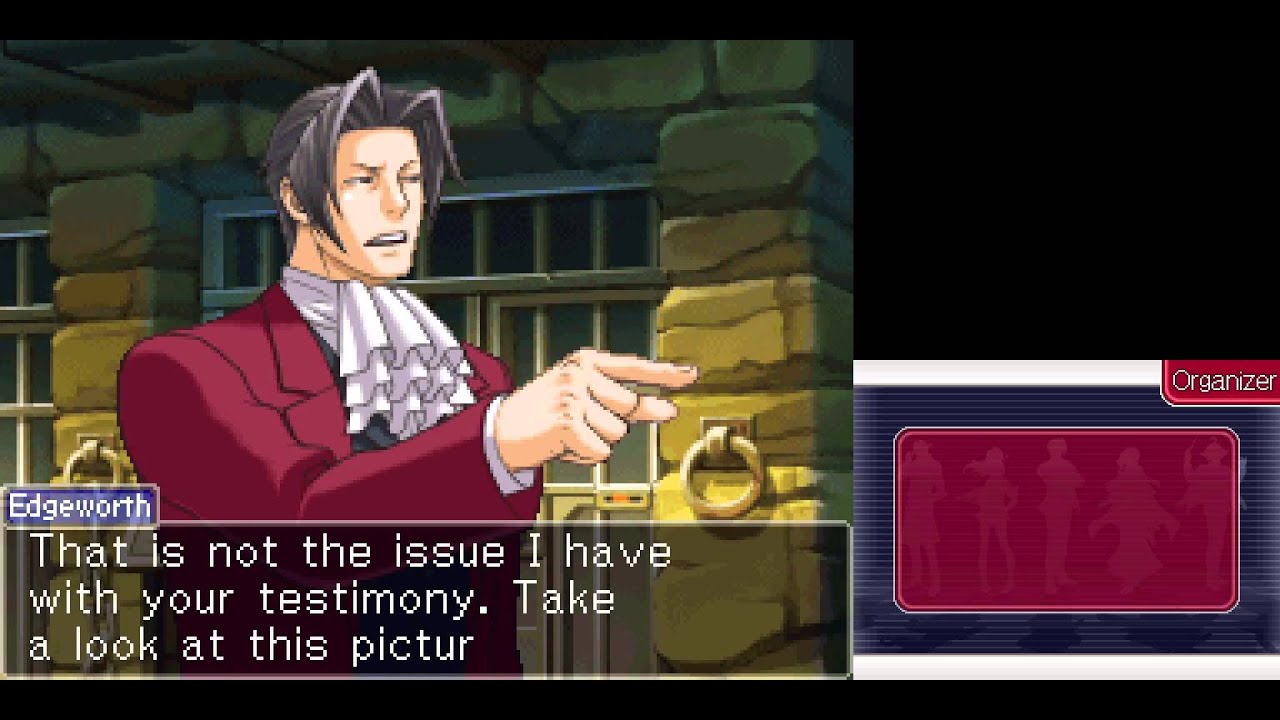
But I'm going to try to have faith that Takumi knows what he's doing but he's going have to pull some magic strings to make this play out with pissing me off on some level. I like the guy but I don't know if he's that good. The in game characters clearly aren't confused about who the disciple is so I don't think Takumi's doing it for the twist reveal.
That's all that's keeping me positive about it.I hope case 4 is shorter because I really want to finish this game this weekend. Well, I don't know what to expect from this game, given the impressions so far.Of course, I don't want to spoil myself since I already saw the entire first game on youtube last year, and would expect to do the same with the second one. Unfortunely that's the only way to understand the story for me.Having said that, I really liked the first one. Thought the characters were great and loved the atmosphere, soundtrack and the story for the most part. Yes it had flaws and left questions unanswered, that I hoped this game wil tackle.Hope that you guys are enjoying it.Reasoning music stops, dead silence.Holmes.Mr. Why did I buy a record in German that I don't understand at all?Naruhodo.I have no idea.Holmes & Naruhodo.Joint Reasoning and music resumes.Naruhodo: This is the reason for your silence!.camera shifts to touch screen.Naruhodo: So why was Iris being so quiet?Susato: But Master Naruhodo, you made that declaration and already pointed your finger?Naruhodo.Naruhodo: Susato, there are times when a man, even when there isn't a thought in his head, must thrust his arm out and point.Susato: I don't understand but alright.This conclusion is looking to be absolutely insane.
There are so many cogs floating around and I can only faintly see how they come together. I'm getting so many 1-4,1-5, and 3-5 vibes from this.The Disciple thing has mostly played out and thankfully it didn't ruin DGS1 like I was afraid it would. I do think it hurt it a bit but still retained what I loved about it. My fear was that Asougi's death was all a fake that he planned or some crap. 'I knew you would volunteer to take my place and our government would allow it if I faked my death in an elaborate scheme that I only had a few days to make up!'
The explanation is still kinda meh and I have to roll my eyes at some parts of it (amnesia gets my vote for laziest plot device but at least it wasn't dragged out or resolved with the 'Power of Friendship')I'll save my overall thoughts on Case 4 until the end so Case 3 now that I'm awake.Case 3 had pretty much everything I love about Ace Attorney. Funny client (voiced by Kappei Yamaguchi, AKA Usopp), absurd premise for a murder. Victim died in the explosion of a teleporter, but the teleporter actually worked because the body was in another tower, very entertaining suspects, sad background story, and the conclusive evidence taking on entirely new meaning right at the last minute. That's what I'm referring to when I was talking about Case 1 underwhelming me with its use of evidence.It was actually a really hard case to solve as well. I got stuck in the investigation phase because I didn't click on a single, tiny book on a desk while it is surrounded by 'desk' which is a different thing to examine altogether.
I also got stumped on two testimonies near the end. On one I had to do the horrible thing of saving and then presenting every piece before it went through.
I got super mad when it finally went though because it didn't make any sense but then Naruhodo starts explaining and I'm like, '.oh. How the hell was I going to figure that out??' The second one was also really tough but luckily I somehow realized the problem which put a new spin on old evidence which is my absolute favorite thing to experience in these games.
That moment when your brain snaps and everything fits together.It felt really busy though and I think that's because Takumi was originally planning on having things spaced out across three games which is why the first had a ton of open threads that he could've slowly resolved but the poor sales forced them all to be answered in one game, with Case 3 getting the bulk of that duty expanding on information. However it didn't feel bloated.
Everything you're investigating and being told about is all very interesting and compelling. It's amusing to realize that this side content completely eclipsed the actual murder case you're trying to solve.
Not going to lie, I audibly said 'oh right' when the conversation finally got back to the World's Fair incident during the last court day. I was disappointed at the breakdown because it is so similar to their 'damaged' animation that it didn't feel distinct enough.
A totally insane final case. So much plot dump and reveals. If they just didn't trip at the last step it'd be one of my top 3 probably.So Case 4 starts really heavy with the victim, defendant, followed by a ton of new faces and information going and the investigation just goes further into the big mysteries in the story.
It's almost half a dozen mysteries to follow yet they seem related somehow that isn't clear. It's really a great mystery story. The best part though was at the end during the final Joint Reasoning, because it finally did what I think was missing from the game so far and that is the hilarious interactions between the cast. This final Reasoning isn't even about something dire or urgent to cracking the case, but just them solving a strange sight in the living room. It gives this air of it just being another afternoon and it's so silly and fun. I would pour all kinds of money into DLC that is just Joint Reasoning gags.
It was a very appreciated change of pace from all the heavy content we had just learned so I felt refreshed before tackling the conclusion in Case 5.Case 5 is simply bonkers with all the changes, twists and reveals. You call Holmes and he just saves the day, boom, bye. You want to talk deus ex machina?
There you go. Freaking gross. One of my favorite things about Naruhodo and Holmes relationship is that neither one outshined the other. I mean you go through all these incidents through the years and you never actually prove Vortex was responsible. He could've argued against the will by saying that's just who older Van Zieks thought was pressuring him but no proof. What I was hoping for and expecting was that he was the one that ultimately shot Genshin in the graveyard, and I think they could've pulled it off by reflecting on something Jigoku said earlier that would discredit Vortex or something. Just having Holmes call in and say 'you're fired' and Vortex gives up is terrible.
I could get that he couldn't claim he can't be arrested because there isn't definitive proof that he did any of that since the Queen could just order him arrested, but couldn't he have said something? I'm thinking of Gant claiming the cloth is illegal evidence as one last pathetic attempt to get out of it but gets shot down in two seconds. Just something like that here. He gets fired by the Queen, claims that there's no proof, Naruhodo objects pointing out something that proves that Jigoku couldn't have been in the graveyard that night so the only one who could've shot Genshin was Vortex, say for all his talk about justice he's just a murderer anyway, breakdown. Also, HUUUUUUGE missed opportunity for not having Big Ben's iconic bell signaling Vortex's downfall. The dude's office is a giant clock tower and he's obsessed with time! Come on!Overall, I liked DGS2 a lot and it felt like a return to the original trilogy in terms of writing and trial proceedings, but it felt really busy.
There's hardly any new characters and there is so much mystery to cover that it can feel overwhelming a bit. The mysteries however are very interesting and complex so it's fun to delve into them. The character interactions are still phenomenal and are always the most memorable parts of the game.
I just wish there were more of them. It's the opposite to DGS1 where 1 was an extremely strong character focused story, but weak mystery and here it's a very strong mystery but not a lot of emphasis on characters. It really feels like you have two game's worth of mysteries crammed into two cases. It worked out on a more than satisfactory level, but it still feels a bit off sadly. You get some character arcs with Van Zieks. Asougi but they're kind of treated in a 'oh, by the way' kind of manner if that makes sense. I'm really sad about the lack of jury interactions.
That's the most unique aspect about DGS gameplay wise and it's all but absent from this. Either they don't interact at all or they cave too easily. In DGS1 they would interject like crazy and help move the game in different directions than the random 'hold it' or 'objection' things.I think I prefer DGS1 more because it was more consistent and focused.
It absolutely benefited from being in a new setting with a new cast. It wasn't just Phoenix and Maya but in the past. It was novel and distinct but still having the charm and excitement of Ace Attorney. DGS1 again had that strong tone going for it. There is a pervading sense of uncertainty and confusion in the game. The events in the first three cases of that game are all thrust upon Naruhodo and he has to respond to them, and in those cases are all filled with people that either hate you, distrust you, or just don't care about you. Which is why the few people that do treat you kindly and side with you are that much more precious like Asougi and Holmes.
DGS1 is always going to have a special place for me because of that despite its flaws. DGS2 just didn't give me that kind of emotional attachment or impact even though it had more twists and surprises. Both games are lacking in either characterization or mystery, so neither game feels complete on their own. Treating them as two pieces to one whole works out a lot better with a goofy middle being DGS2-1 and DGS2-2.
It reminds me of the animes from the 90s like Trigun and Outlaw Star where the first half of the series was more light-hearted and fun because it was introducing the characters and their interactions before the second half put them to the grindstone.I don't think video games are a medium that benefit from being open ended. Actually I know they don't at this point. It raises the exceptions of the players and puts too much pressure on the sequel to live up to them instead of being their own experience and world. AA3 worked out so well because it took advantage of vague side information that wasn't directly important to the game they were introduced in. The closest we got was Morgan's statement to herself at the end of 2-2.
That's why when AA3 started linking to past events it was more satisfying and made AA3 have a greater sense of scale, making for a more intense conclusion. DGS2 exists just to answer the intentional open questions of the first game making for some questionable character choices and rushed some plot threads.Still, it was a great ride for the vast majority of it and I'm curious to see how it performs on replay.in a year or something. I played the entire series again before this came out so I am Ace Attorney'd OUT. One of the most creative takes on a timeless character.Follow your spirit, and upon this charge. Cry ”God for Harry, England, and Saint George!'
Dai Gyakuten Saiban 2: Naruhodou Ryuunosuke no Kakugo / The Great Ace Attorney 2: The Resolve of Ryuunosuke NaruhodouRelease Date: August 3rd, 2017 JapanDirector/writer: Shuu TakumiProducer: Motohide EshiroSummaryIt's been two years since we all boarded Mr. Takumi's wild ride, only to be stopped just before the loop-the-loop and told to deboard. But for Ryuunosuke and co.
It's only been a few months since they cracked the case of the unspeakable story. Now, a new crime in Japan leads an unexpected attorney to stand in court for the first time, and a new chain of cases to descend upon London.QuestionsWill this be officially released in English?Okay, but can I play it in English?recently won the rights to get their translation restored to YouTube, and they intend to sub DGS2 as well.The DGS1 fan translation patch team is still neck-deep in the first game, but they've already started updating their tools for DGS2.Do I have to have played/watched the first game to play/watch this one?Yes. Unlike every other AA game in the series, DGS2 is a direct sequel to DGS1, with the premise of its plot being that it will serve as a continuation and conclusion of DGS1's plotlines. I'm sure there will be some recapping in-game, but you'll lose a lot of the impact playing it before DGS1.Okay, I want to play DGS1 first.If you speak Japanese, a special double-pack of DGS1+2 (with a pack-in soundtrack) is available at most Japanese retailers and online. If you don't, or you can import a Japanese copy and wait for the fan translation patch.Any new features compared to DGS1?Not really.
The main 'special' features in the game remain Joint Reasoning and the Jury Battles.I heard the soundtrack is the same as DGS1?From what we've heard, the vast majority of the courtroom tracks are reused from DGS1, as are a few others; however, DGS2's soundtrack releases next week, and is slated to have 40+ tracks, so there should be a good amount of new music.What are the episodes about?Shuu Takumi has said you'll have the best experience going in blind, but if you want to know the basics of each case:Episode 1. London's World Fair gets off to a tragic start when a teleportation experiment ends in an explosion that kills a man. Ryuunosuke takes on the scientist's defense, but there seems to be much more lurking in the shadows. Episode 4:???Episode 5:???I played DGS1 but the lack of conclusion left me cold. This isn't just a setup for DGS3, is it?The dev team and reviews have been very explicit that they wrap up all of the DGS1 plotlines in this game, and Takumi's made comments to the effect that he feels he's told these characters' story now.Resources:for further discussion, rips, etc.
disclosure, I help run this(as always, be very cautious of spoilers and misinfo immediately after release). As the trailer and every advertisement for DGS2 has stated, 'Now all the mysteries will be answered'. I've assembled little summaries of said mysteries to look out for and to remind people who may have forgotten (and for you lizard people that don't care about spoilers).All these spoilers are from Dai Gyakuten Saiban 1 unless stated otherwise. I'm not going to be updating these as time goes on with 'answers' or whatnot. There are other, smaller mysteries as well, but I think they will be answered in the course of pursuing these main ones.I have no issue deleting these if it is considered too tempting or too much info. I just think it's interesting to keep these in mind for a refresher or to keep in the forefront of our thoughts while playing, kind of like reviewing Virtue's Last Reward before Zero Time Dilemma came out.
Hopefully this won't be as divisive.Also I want to see if I massively misread things.Case 1. We learn from the DGS2 web demo that it has been 9 months since that trial and finally after deliberations with England and Japan it was decided Jezail would be sent to Shanghai to undergo trial at an English court there. Jezail had a final request to go to a private beach for her last day in Japan which England accepted and pressured Japanese government to comply, which they quickly caved to again.
However in a changing shack at the beach, Jezail was found stabbed to death making her the victim of the first case.Case 2. One of the primary causes of the case's events is Iris lamenting the complications with one of her latest manuscripts. For people not in the know, Iris is the secret author of the 'Adventures of Sherlock Holmes' stories published in Strandts magazine while using her father as pen name. She writes her stories based on Holmes recounting his adventures to her but primarily she does so using a collection of journals her father, John Watson, wrote during his travels with Holmes.
She had finished writing a new manuscript, 'Baskerville' and showed it to Holmes to proof read and permission to publish it. Instead in a rare showing of genuine sternness from Holmes, he forbade her from publishing the story and not only that but deposited the manuscript to a local pawnshop, Hatch's Shop. Susato expresses her disappointment at not being able to read about 'the Hound of the Baskervilles'. Iris turns serious and asks, '.How did you know the title?' In their conversation, Iris only referred to her manuscript as 'Baskerville' yet Susato knew the entire title. Susato since then has refused to explain how even at the game's conclusion, but has promised to do so when the time is right. Van Zieks does not hold the Japanese people in high regard, calling them liars, tricksters, and traitors with no respect for law officers among many other decrying comments.
It isn't until after the final trial concludes that he explains himself slightly to Naruhodo. In the past, there was a Japanese person that Van Zieks had absolute faith in but later betrayed him. After meeting Naruhodo in Case 3, Van Zieks would intentionally take what the public considered 'simple cases with obvious culprits' such as Case 4 and 5 solely so he could observe Naruhodo. We also learn that five years ago, Van Zieks left the courts and it was then that he became known as 'The Reaper'. He never returned to court again until the events of Case 3. It's possible that the Reaper's curse is an exaggeration from a gossip-loving populace that resulted from some incident five years ago and this incident could be the reason he left the courts. What happened between Van Zieks and his Japanese friend, and what happened five years ago that made him leave the courtroom and be known as The Reaper of Old Bailey?
The events of Case 3 and 5 originated in the aftermath of illegal trafficking of telegraph Morse code messages. The message was eventually played in court, but it was determined to be secret code instead of Morse code so no one knew what the message actually said. Iris wrote down part of the message to attempt to translate it later and after the trial realized that the message was indeed Morse code but not in English. Rather it was done in 'Iroha' code, an early format of the Japanese alphabet, meaning this top secret and classified message from the English Empire was most likely sent to the Japanese Empire. Using this knowledge, Susato decoded the partial message and found it was a list of names.' Asougi (Kazuma Asougi)A. Sasha (unknown)T.
Gregson (Tobias Gregson)J. Watson (John Watson)These are the four.' This message was so important that its recovery demanded the full force of Scotland Yard and even murders were committed to acquire it.
What was this transmission? What is the significance and relationship of these four people?Still haven't caught on to how time zones work and didn't realize the digital version would get unlocked tomorrow morning while I'm at work. I took Thursday and Friday off so hopefully I can demolish it before I go back to work and before Youtube recommended videos show me every breakdown in their thumbnails -. I was thinking you were exaggerating, but no, that was actually the greatest comedic breakdown ever.Unfortunately that was about all the case had going for it I thought.There was no sense of tension or development for Susato which made me really sad because of her statements near the start like this one moment making her 'hate being born a woman' or how the 'courts defend everyone yet don't accept women.'
I know they couldn't 'solve' it since it was a historical fact, and it'd be really lame to have the other characters play it so on the nose to acknowledge how flawed that mindset of barring women just because Susato did a good job, but still I wish we did something with it. I was really interested in seeing how Susato would've have responded and persevered in the face of that, but it's just given a line at the start and dropped.It's pretty much a case just to give context and setup for later events and that's crammed in the last five minutes. It makes for a good ending but the actual case was probably the tamest I can think of. Every case, even 1-1 had some semblance of changing your thinking about something but this was just.dull.
You don't even poke one of the other witnesses mid-testimony. One of the things I noticed when replaying the series again recently before this launched was how well the control of information can be used for the best twists, with the worse examples always resulting from giving too much information too soon. This case did that A LOT.
Crime scene photo has a glaring hole in the shack's wall. Gee, I wonder where the knife came from?
And that's the mid-game plot twist. You need to examine the pen early on and you find the reservoir with some liquid in it. Gee, I wonder where the poison was hidden? And that's the closing twist.It's like the opposite of DGS1-1 where the first case was great but went on way too long while this one is dull but short. I suppose it evens out for me because -to be perfectly frank, outside of playing as Susato I couldn't give a shit about being in the Japanese Empire again.
It's obvious that the meat of the story, both cast and conspiracies, is in England so the sooner we got back there the better.But I'm a cynical old man hipster that doesn't like anything, so there's that to consider.I think I'm actually going to start Case 2 tonight just to 'start DGS2 for reals' after some Splatoon. I was thinking you were exaggerating, but no, that was actually the greatest comedic breakdown ever.Unfortunately that was about all the case had going for it I thought.There was no sense of tension or development for Susato which made me really sad because of her statements near the start like this one moment making her 'hate being born a woman' or how the 'courts defend everyone yet don't accept women.'
I know they couldn't 'solve' it since it was a historical fact, and it'd be really lame to have the other characters play it so on the nose to acknowledge how flawed that mindset of barring women just because Susato did a good job, but still I wish we did something with it. I was really interested in seeing how Susato would've have responded and persevered in the face of that, but it's just given a line at the start and dropped. It's pretty much a case just to give context and setup for later events and that's crammed in the last five minutes. It makes for a good ending but the actual case was probably the tamest I can think of.
Every case, even 1-1 had some semblance of changing your thinking about something but this was just.dull. You don't even poke one of the other witnesses mid-testimony. One of the things I noticed when replaying the series again recently before this launched was how well the control of information can be used for the best twists, with the worse examples always resulting from giving too much information too soon. This case did that A LOT. Clearly showing Mr. Hat and the body getting hoisted into the air.
That video just told you that the body was moved from the stage via wires at the very start of the case but no one acknowledges it until the very end. It creates disconnect because you know more than the characters do so when they're struggling to answer something that the game clearly told you already it makes them appear less competent. Especially when the characters finally do explain that obvious point there was no prompt that justified how they finally caught up.Evidence should have two points to it: the initial fact and then a 'real' fact about it that is hidden until the case progresses and gives that secondary fact context and exposure. In DGS2-1's case it would've been better if. You couldn't find the empty ink reservoir when examining it. Instead examining just told you about the emblem which makes Payne's argument the pen, the initials, moot and incriminates Mamemimo later. Then wait until the end of the case to have some line of action reveal that the pen is empty or that you see how this fountain pen works, making you realize the pen was actually the real murder weapon.
Heck, he kept tapping his pencil on his tongue, couldn't that have been a more interesting way for the poison to be administered? Like he asks you 'There were no lip marks on her drinking glass! How would I get her to take the poison?
You can't prove that!' And you present the pen at this point. That would be similar to DGS1-1 and initially presenting the. I thought Selden's treasure was hidden in a fake gas meter box.
That padlock on it looked exactly like the key Viridian had and the first court day had the wasp lady and Mieterman talking about how tamper-proof the boxes were. Of course thinking on it, that wouldn't work since Mieterman checks the boxes every three days for coins.
He'd notice a fake box. I also got stumped at the 'true killer' point because Viridian was in a coma on the night of the incident so I didn't even consider her. I am surprised that they went through the trouble of having her paint on the stand and yet she didn't nothing with those props.
Wasted opportunity.Still felt kind of rushed though. These first two cases seem like they were going down a checklist of things they need to establish.
'Something's fishy with Japan's relationship with England: check. Asougi had something to do in England: check. Van Zieks hates the Japanese and he's The Reaper: check.' It reminds me of AA3 in that regard like how 3-2 was mainly meant to refresh on Spirit Channeling and the extended Fey family tucked away in a murder case.I wish I had more to say about these cases so far but there hasn't been anything new. No new characters or new interactions. They're just DGS1 cases but faster and without the somber melancholy.There's definitely something to be said about the different tone and pacing between these two games.
DGS1 felt like one long, continuous story while DGS2 so far feels like the original trilogy games did with clear chunks of standalone story that are faintly interconnected. Download mp3 triad madu tiga. DGS1 had a very clear tone of uncertainty and alienation. I'm two cases in to DGS2 and I have no idea what the tone is supposed to be, but again I think that's because these first two cases are meant to refresh on the previous game's unresolved matters asap. AA3 didn't really kick into gear until case 4 and then 5 went all out.Finally getting into post-DGS1 content with Case 3 tomorrow when the. I think Susato as lawyer worked nicely and was a fun spin.When I first saw the camera guy I was all 'THAT'S THE KILLER' in a joking way and as the case progressed I always kept that in my mind, and when I realized it was actually happening I was so thrilled.
I also like how they managed to set up a 'yeah so I stabbed her but even if I hadn't stabbed her she was going to die from poison anyway' scenario,haha. After the case is interesting since they obviously are trying to tie loose ends together,I presume we'll learn more case 2. Professor wax figure. They're hyping up the reveal and sneaking a peak at him and.he's missing his head.
You find the head later.and it's wearing an iron mask because it doesn't have a face underneath it at all.But I am very concerned about this 'Masked Disciple' business. Depending on how it plays out I'm going to outright loathe both of these games. It has already put possibly my favorite aspect of DGS1's story and Naruhodo's characterization in serious jeopardy.
If they take that away for a 'what a tweest', I'm going to be absolutely livid. Legit screaming anger. I can't stand those kinds of plot twists. But I'm going to try to have faith that Takumi knows what he's doing but he's going have to pull some magic strings to make this play out with pissing me off on some level.
I like the guy but I don't know if he's that good. The in game characters clearly aren't confused about who the disciple is so I don't think Takumi's doing it for the twist reveal. That's all that's keeping me positive about it.I hope case 4 is shorter because I really want to finish this game this weekend. Well, I don't know what to expect from this game, given the impressions so far.Of course, I don't want to spoil myself since I already saw the entire first game on youtube last year, and would expect to do the same with the second one.
Unfortunely that's the only way to understand the story for me.Having said that, I really liked the first one. Thought the characters were great and loved the atmosphere, soundtrack and the story for the most part. Yes it had flaws and left questions unanswered, that I hoped this game wil tackle.Hope that you guys are enjoying it.Reasoning music stops, dead silence.Holmes.Mr. Why did I buy a record in German that I don't understand at all?Naruhodo.I have no idea.Holmes & Naruhodo.Joint Reasoning and music resumes.Naruhodo: This is the reason for your silence!.camera shifts to touch screen.Naruhodo: So why was Iris being so quiet?Susato: But Master Naruhodo, you made that declaration and already pointed your finger?Naruhodo.Naruhodo: Susato, there are times when a man, even when there isn't a thought in his head, must thrust his arm out and point.Susato: I don't understand but alright.This conclusion is looking to be absolutely insane. There are so many cogs floating around and I can only faintly see how they come together. I'm getting so many 1-4,1-5, and 3-5 vibes from this.The Disciple thing has mostly played out and thankfully it didn't ruin DGS1 like I was afraid it would. I do think it hurt it a bit but still retained what I loved about it.
My fear was that Asougi's death was all a fake that he planned or some crap. 'I knew you would volunteer to take my place and our government would allow it if I faked my death in an elaborate scheme that I only had a few days to make up!' The explanation is still kinda meh and I have to roll my eyes at some parts of it (amnesia gets my vote for laziest plot device but at least it wasn't dragged out or resolved with the 'Power of Friendship')I'll save my overall thoughts on Case 4 until the end so Case 3 now that I'm awake.Case 3 had pretty much everything I love about Ace Attorney. Funny client (voiced by Kappei Yamaguchi, AKA Usopp), absurd premise for a murder.
Victim died in the explosion of a teleporter, but the teleporter actually worked because the body was in another tower, very entertaining suspects, sad background story, and the conclusive evidence taking on entirely new meaning right at the last minute. That's what I'm referring to when I was talking about Case 1 underwhelming me with its use of evidence.It was actually a really hard case to solve as well. I got stuck in the investigation phase because I didn't click on a single, tiny book on a desk while it is surrounded by 'desk' which is a different thing to examine altogether. I also got stumped on two testimonies near the end. On one I had to do the horrible thing of saving and then presenting every piece before it went through. I got super mad when it finally went though because it didn't make any sense but then Naruhodo starts explaining and I'm like, '.oh. How the hell was I going to figure that out??'
The second one was also really tough but luckily I somehow realized the problem which put a new spin on old evidence which is my absolute favorite thing to experience in these games. That moment when your brain snaps and everything fits together.It felt really busy though and I think that's because Takumi was originally planning on having things spaced out across three games which is why the first had a ton of open threads that he could've slowly resolved but the poor sales forced them all to be answered in one game, with Case 3 getting the bulk of that duty expanding on information. However it didn't feel bloated. Everything you're investigating and being told about is all very interesting and compelling. It's amusing to realize that this side content completely eclipsed the actual murder case you're trying to solve.
Not going to lie, I audibly said 'oh right' when the conversation finally got back to the World's Fair incident during the last court day. I was disappointed at the breakdown because it is so similar to their 'damaged' animation that it didn't feel distinct enough. A totally insane final case. So much plot dump and reveals. If they just didn't trip at the last step it'd be one of my top 3 probably.So Case 4 starts really heavy with the victim, defendant, followed by a ton of new faces and information going and the investigation just goes further into the big mysteries in the story.
It's almost half a dozen mysteries to follow yet they seem related somehow that isn't clear. It's really a great mystery story.
The best part though was at the end during the final Joint Reasoning, because it finally did what I think was missing from the game so far and that is the hilarious interactions between the cast. This final Reasoning isn't even about something dire or urgent to cracking the case, but just them solving a strange sight in the living room. It gives this air of it just being another afternoon and it's so silly and fun. I would pour all kinds of money into DLC that is just Joint Reasoning gags. It was a very appreciated change of pace from all the heavy content we had just learned so I felt refreshed before tackling the conclusion in Case 5.Case 5 is simply bonkers with all the changes, twists and reveals. You call Holmes and he just saves the day, boom, bye. You want to talk deus ex machina?
There you go. Freaking gross. One of my favorite things about Naruhodo and Holmes relationship is that neither one outshined the other. I mean you go through all these incidents through the years and you never actually prove Vortex was responsible.
He could've argued against the will by saying that's just who older Van Zieks thought was pressuring him but no proof. What I was hoping for and expecting was that he was the one that ultimately shot Genshin in the graveyard, and I think they could've pulled it off by reflecting on something Jigoku said earlier that would discredit Vortex or something.
Just having Holmes call in and say 'you're fired' and Vortex gives up is terrible. I could get that he couldn't claim he can't be arrested because there isn't definitive proof that he did any of that since the Queen could just order him arrested, but couldn't he have said something? I'm thinking of Gant claiming the cloth is illegal evidence as one last pathetic attempt to get out of it but gets shot down in two seconds. Just something like that here. He gets fired by the Queen, claims that there's no proof, Naruhodo objects pointing out something that proves that Jigoku couldn't have been in the graveyard that night so the only one who could've shot Genshin was Vortex, say for all his talk about justice he's just a murderer anyway, breakdown.
Also, HUUUUUUGE missed opportunity for not having Big Ben's iconic bell signaling Vortex's downfall. The dude's office is a giant clock tower and he's obsessed with time! Come on!Overall, I liked DGS2 a lot and it felt like a return to the original trilogy in terms of writing and trial proceedings, but it felt really busy.
There's hardly any new characters and there is so much mystery to cover that it can feel overwhelming a bit. The mysteries however are very interesting and complex so it's fun to delve into them.
The character interactions are still phenomenal and are always the most memorable parts of the game. I just wish there were more of them. It's the opposite to DGS1 where 1 was an extremely strong character focused story, but weak mystery and here it's a very strong mystery but not a lot of emphasis on characters. It really feels like you have two game's worth of mysteries crammed into two cases.
It worked out on a more than satisfactory level, but it still feels a bit off sadly. You get some character arcs with Van Zieks. Asougi but they're kind of treated in a 'oh, by the way' kind of manner if that makes sense. I'm really sad about the lack of jury interactions.
That's the most unique aspect about DGS gameplay wise and it's all but absent from this. Either they don't interact at all or they cave too easily. In DGS1 they would interject like crazy and help move the game in different directions than the random 'hold it' or 'objection' things.I think I prefer DGS1 more because it was more consistent and focused. It absolutely benefited from being in a new setting with a new cast. It wasn't just Phoenix and Maya but in the past. It was novel and distinct but still having the charm and excitement of Ace Attorney.
DGS1 again had that strong tone going for it. There is a pervading sense of uncertainty and confusion in the game. The events in the first three cases of that game are all thrust upon Naruhodo and he has to respond to them, and in those cases are all filled with people that either hate you, distrust you, or just don't care about you. Which is why the few people that do treat you kindly and side with you are that much more precious like Asougi and Holmes. DGS1 is always going to have a special place for me because of that despite its flaws.
DGS2 just didn't give me that kind of emotional attachment or impact even though it had more twists and surprises. Both games are lacking in either characterization or mystery, so neither game feels complete on their own. Treating them as two pieces to one whole works out a lot better with a goofy middle being DGS2-1 and DGS2-2. It reminds me of the animes from the 90s like Trigun and Outlaw Star where the first half of the series was more light-hearted and fun because it was introducing the characters and their interactions before the second half put them to the grindstone.I don't think video games are a medium that benefit from being open ended. Actually I know they don't at this point.
It raises the exceptions of the players and puts too much pressure on the sequel to live up to them instead of being their own experience and world. AA3 worked out so well because it took advantage of vague side information that wasn't directly important to the game they were introduced in.
The closest we got was Morgan's statement to herself at the end of 2-2. That's why when AA3 started linking to past events it was more satisfying and made AA3 have a greater sense of scale, making for a more intense conclusion. DGS2 exists just to answer the intentional open questions of the first game making for some questionable character choices and rushed some plot threads.Still, it was a great ride for the vast majority of it and I'm curious to see how it performs on replay.in a year or something.
I played the entire series again before this came out so I am Ace Attorney'd OUT. One of the most creative takes on a timeless character.Follow your spirit, and upon this charge. Cry ”God for Harry, England, and Saint George!'