Pwm Stepper Motor Control
DC Motor Speed Control Using Arduino & PWMSpeed control of DC motor with PC Interface is an easy DIY project. In this project DC motor’s speed is controlled by sending the command through PC.
Arduino is directly connected to PC through the USB cable and command is given to Arduino on serial monitor of the Arduino IDE.Motor is connected to a transistor, and the base of transistor is connected to PWM pin of Arduino and motors speed is varied according to PWM signal coming from Arduino. Arduino DC Motor Control – WorkingArduino is connected to PC through the USB cable. We can send the command to PC on the serial monitor.
We can change the speed of motor from 0 to 9. When 0 is sent over the Serial Monitor, the motor runs at minimum speed (that is zero). When the speed is varied from 1 to 9, the speed increases, with the value 9 set as the maximum speed of the motor.A PWM DC motor controller technology is used to control the speed. In PWM, the Arduino sends a pulsating wave that is similar to astable mode of 555 timer IC. PWM Speed Control (Pulse Width Modulation)Microcontroller and Arduino are digital devices; they cannot give the analog output.
Pwm Stepper Motor Control With Arduino
Microcontroller gives Zero and ONE as output, where ZERO is logical LOW and ONE is logical HIGH. In our case, we are using 5 volt version of the Arduino. So it’s logical ZERO is zero voltage, and logical HIGH is 5 voltage.Digital output is good for digital devices but sometimes we need the analog output. In such a case the PWM is very useful. In the PWM, output signal switches between zero and one, on high and fixed frequency, as shown in the figure below. Output Signal of PWMAs shown in the above figure the ON time is “Ton” and the OFF time is “Toff”. T is the sum of the “Ton” and “Toff” which is called the Time Period.
In the concept of PWM “T” is not varying and the “Ton” and the “Toff” can vary, in this way when “Ton” increase “Toff” will decrease and “Toff” increase when “Ton” decrease proportionally.The duty cycle is the fraction of one Time period. Duty cycle is commonly expressed as a percentage or a ratio. A period is the time it takes for a signal to complete an on-and-off cycle. As a formula, a duty cycle may be expressed as: DUTY CYCLE = (Ton ÷ T) x100%Now the motor’s speed varies according to duty cycle. Suppose the duty is zero, motor does not run and when duty cycle is 100% the motor moves on maximum RPM. But this concept is not always right because motor starts running after giving some fixed voltage that is called threshold voltage.
Transistor (2N2222)Microcontroller and the Arduino can process signals and consumes almost 20 to 40mA current but motors need high current and voltage, so we are using the transistor for driving the motor. Transistor is connected in series with motor and transistor’s base is connected to Arduino’s PWM pin through a resistance.
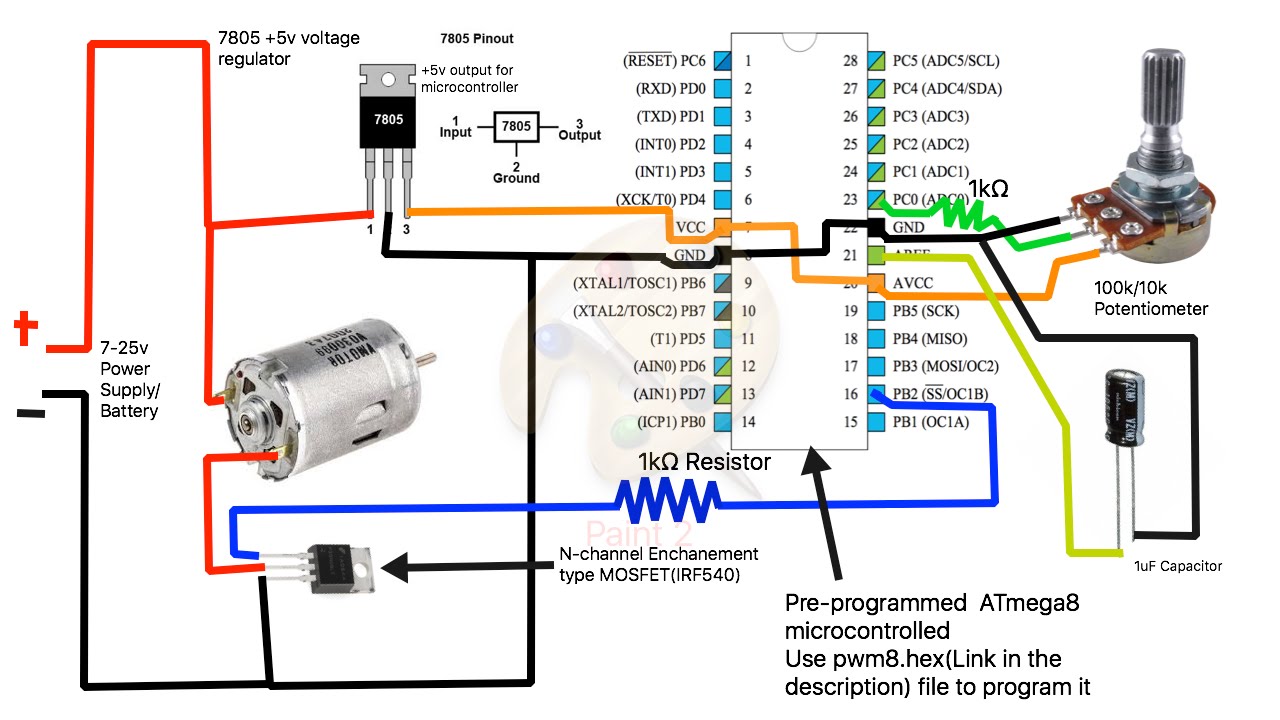
PWM signal is coming from Arduino and the transistor works as a switch and it short circuit the Emitter (E) and Collector (C) when PWM signal is in High state and normally opens when PWM signal is in LOW state. This process works continuously and the motors runs at desired speed. Components ComponentsSpecificationQuantityArduinoNano1DC MotorLow Power1Transistor2N2221Power Adapter12 Volts1Resistance1K1Diode1N40041USB CableFor Arduino Nano1Arduino DC Motor Control – CircuitCircuit diagram is shown in the figure below. If you are making this circuit on the general purpose PCB (ZERO PCB) or breadboard, this figure is useful. Speed Control of DC MotorIn the circuit an is used, which is very small in size and Breadboard friendly.A transistor’s (2n2222) BASE pin is connected to D9 pin of Arduino through a Resistance of 1k ohm, Resistance is used for current limitation.
Motor is connected between collector pin of transistor and Vcc. A diode (1n4004) is connected parallel to the motor in reverse bias; it is used for blocking the reverse current. Emitter pin of the transistor is connected to the ground. This circuit is powered by a 12 volt adapter. Arduino PWM Motor Control – Video.
Arduino PWM Motor Control DC Motor Speed Control – Download ProgramIn the beginning of the code two integers are declared by name “out1” and “val”, where out1 is equal to 9 which shown that pin D9 of Arduino is used as output pin (or PWM pin). Moreover, data coming from the serial monitor saved in the second integer “val”.In the void setup serial communication is begin by using function “Serial.begin(9600)” where 9600 is the baud rate of serial monitor.
After it “out1” is declared as output because the motor is an output device.In the void loop “serial.available” is used inside the “if” condition, it become true when any data is sent over the serial monitor. This data is saved in “val” integer using “Serial.read” function.After it many “if” conditions are used, in the first “if condition”, when ‘0’ is sent through the serial monitor, it become true. In the bracket “analogWrite(out1, 0)” is used for running the motor at the zero PWM value. In the function “analogWrite (out1, 0)”, “out1” is used to indicate the pin which we want to use and “0” is the PWM value at this pin. After it “Speed is = 0” is shown on serial monitor using “Serial.println” function. After it the integer “val” is updated to 10, where 10 is the random value, which is other than 0 to 9.In the next line if condition is used for “val 1”, at this time motor runs at PWM value of 175. Same conditions are used upto 9, at the 9 motor runs at 255 PWM value, 255 is the maximum PWM value.
Process. Connect the Arduino through USB and upload the code. Open the serial monitor and set the baud rate at 9600.
Now type any number from 0 to 9.After typing any value from zero to 9, speed of the motor varies, but we cannot see varying speed in video properly, but you can see it live. Sort By Type. (30). (16).
(26). (21). (39). (70). (3). (104).
(28). (23). (1). (17). (23). (7). (14).
(1). (5). (7). (2).
(10). (2). (2). (11). (1). (7).
(31). (3).
(10). (5). (7). (1). (3).
(1). (16). (3). (14). (6). (15). (2).
(1). (26). (35). (15). (1).
(1). (13). (20). (5). (20). (3).
(14). (44). (3). (12). (3). (14). (14).
(25). (2).
(29). (8).
(3). (72). (12).
(1). (7). (16). (3). (30).
(19). (3). (3). (12).
Stm32 Pwm Motor Control
(8). (7). (2). (17). (16). (11).
(13). (1). (2).
(6). (86). (9). (4). (3). (38). (9).
(1). (3). (20). (6). (7). (163). (2).
(3). (5). (36). (15). Das buch der geheimnisse osho pdf books 2017.
Stepper Motor Control Pdf
With our new project, we are very keen to support the development of open source control software for laser cutters. We are more than happy for people to modify our, replace the control system with something suitably open source and then let us know how it goes. Realistically though we’re going to have to figure these things out for ourselves so we can guide other people through the process.There are a lot of tutorials online detailing the hardware PWM features of the arduino and how it relates to servo motor control. This instructable will show you how to use the hardware PWM to control a stepper motor instead. We’ll start with the basics of PWM, show briefly how it relates to servo motors and then show the differences for use with stepper motors. Pulse Width Modulation (PWM) is a technique for creating a digital square wave signal. A square wave has 3 main characteristics. Amplitude – The amount the signal changes between On and Off states.
Frequency – The number of times the signal repeats in a given time frame. Duty Cycle – The proportion of On time to Off time usually expressed as a percentageIn these digital systems the amplitude is fixed between 0 and 1, between 0V and VCC. In my testing this was +5V.In it’s simplest form a PWM square wave can be created with a few lines of code. The following code would produce a signal with a 1 second Frequency and a 10% duty cycle.
This would be functional but the Arduino would be dedicated to producing this signal the whole time and would not do anything else. This is why the example is so important to learn. DigitalWrite(IOPin, HIGH);delayMicroseconds(100);digitalWrite(IOPin, LOW);delayMicroseconds(900);With a software generated signal any variation in the code execution time can cause variations in the output. Conditional statements may not execute on every loop so it is hard to guarantee that each loop will take exactly the same amount of time. Modern microcontrollers have dedicated hardware modules to generate a code independent square wave.
Values for Duty cycle and Frequency are written to registers within the controller and the hardware generates the appropriate signal on the desired output pin.The registers for the Hardware PWM module can be written to directly as, but the joy of the Arduino environment is that somebody is likely to have written a library to simplify that process. The provides control over the HardwarePWM module connected to timer 1 (aptly). This library has easy functions for setting the frequency and duty cycle of the square wave being generated. pwm(pin, duty, period) – Generates a PWM waveform on the specified pin.The minimum freqeuncy supported by the library is 1ms and the maximum is 8.3s. The duty is specified as a 10 bit value, between 0 and 1023, and this correlates to the 0% and 100% values respectively.
Step 2: PWM for servo control. For servo control the Frequency of the signal is fixed, and the duty cycle varies.Servos accept a common control signal, a square wave with a repeat frequency of 20ms and an on period of 1ms (5%) to 2ms (10%).
It is the width of the on pulse that indicates what angle the servo should be at.Here is the code to set up the two extreme signals using the Timer one libraries. pwm(9, 51, 20000);. pwm(9, 102, 20000);You’ll note that using this method there are only 50 steps between the minimum angle and the maximum angle, this is sufficient resolution for most basic systems. There are better methods for controlling the servo to provide more accurate resolutions but they are beyond the scope of this instructable. A is a brushless DC electric motor that divides a full rotation into a number of steps. This motors position can be determined by counting the number of steps that have been commanded providing of the system.
A stepper motor driver is typically added to the system to power the stepper motor and simplify the control into step and direction pulses. Each pulse on the step line causes the motor to move a step, or part step, in a give direction.For stepper motor driver control the duty cycle can be fixed and the Frequency varied.The stepper motor driver expects a series of input pulses to move the motor to any given angle. The driver moves the motor one step for each input pulse. The direction of the motor is set by the second input.